St Patrick’s Day Craft: How to make Paper Shamrocks

These Paper Shamrocks are so easy and really fun to make. We spent Saturday afternoon making all kinds of crafts and these were our favourite. They’re pretty quick to make, especially if you use a stapler and it wouldn’t take any time at all to rustle up enough to really decorate a room for St Patrick’s Day.

The idea is very similar to the paper heart wreath I made for Valentine’s Day. The 3D hearts are very simple to make with a strip of paper and look really effective when put together into a wreath or shamrock.

St Patrick’s Day Craft: How to make Paper Shamrocks

HOW TO MAKE A PAPER Shamrock

You will need
Green paper or card, A4 size
Scissors
A ruler and pencil
Stapler with staples
A length of ribbon if you’re hanging your shamrock

How to make your Paper Shamrock

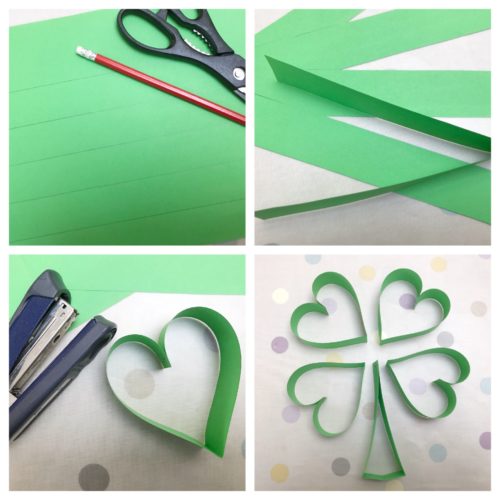
Using a ruler measure the long side of your piece of paper and divide that length by five. Measure out five equal widths of paper and carefully cut into strips using a pair of scissors. If you’re doing this with children then you may want to be in charge of this bit.

Fold four of the strips in half, make sure you’ve got a neat, crisp fold here, this will be the pointy bottom of your heart shape. Bend the edges together to create the heart shape and staple the ends together. Do this with all four strips of paper to make hearts.

St Patrick’s Day Craft: How to make Paper Shamrocks

With the fifth strip (see the picture) you want to fold it into a very tall triangle shape with a flat bottom. Staple the ends together.

Lay the heart shapes out with the pointy triangle in the middle. It’s easier to visualise how to put the paper shamrock together. I found it easier to line up the bottom two hearts with the top of the triangle stem and staple them together. Before you staple the other hearts to the top of the paper shamrock shape, make a loop with your ribbon and staple it in place, then staple the other hearts together and your paper shamrock is done.

Hang up your Paper Shamrocks wherever you like and celebrate St Patrick’s Day with pride!

St Patrick’s Day Craft: How to make Paper Shamrocks

Six Children’s Books about Vikings

Fresh from our adventures at the JORVIK Viking Festival in York, we’ve been full of love for all things Viking. While we were there I popped into a bookshop and picked up a few more books about Vikings to add to our collection.

We do really enjoy picking a topic and reading all about it. I try and match it with the things he’s learning at school too, I’m so pleased that this term he’s learning about Vikings at school, because who doesn’t love a Viking?

Six Children’s Books about Vikings

Vikings and Invaders (Hysterical Histories) by Anita Ganeri is a brilliant book for young Viking fans. It is a press-out and play book which is packed with curriculum appropriate information, Viking facts and lots of play value. There are Vikings and invaders to press-out and play with. We particularly enjoyed reenacting Viking scenes and playing with the press-out long boat!

Six Children's Books about Vikings

Anglo-Saxons & Vikings (Usborne History of Britain) by Hazel Maskell and Dr Abigail Wheatley is a really comprehensive book which covers Anglo-Saxon society; through the invasion of the Vikings and right up to the Battle of Hastings. This is a very detailed book which is easy to flick through to look up the information you need. This book is highly recommended if you’re learning about Vikings.

The World of Vikings by Robert Macleod – This 80 page, colourfully illustrated history book is full of facts about the Viking age. Each page is lush with illustrations and images, which really bring the facts to life. With maps, timelines, photographs of relics and illustrations about what life was like for Vikings, it’s filled with detail which will really capture the imagination of readers. Read our full review here.

Everything Vikings: All the Incredible Facts and Fierce Fun You Can Plunder (National Geographic Kids) by Nadia Higgins. Do you think of Vikings and think hats with horns and flying dragons? You may well be wrong. This National Geographic Kids book is packed with Viking facts and illustrations.

Horrible Histories Vicious Vikings by Terry Deary andMartin Brown. You can’t have a children’s history book round up without including at least one Horrible Histories book. This series is well known for being interesting and exciting for kids, as well as fact-packed and engaging. Vicious Vikings is no different, with facts about Viking Gods in wedding dresses, corpses on trial and death by booby-trapped statues, there’s something for every young Viking fan!

The Story of the Vikings Sticker Book by Megan Cullis. Everyone loves a sticker book, and this is a really good one. Follow the incredible story of the Vikings as they terrorized the coastlines of Europe for over 300 years; from their infamous adventures overseas to the splendid treasures they left behind. This is a beautifully illustrated sticker book, packed with information and photographic stickers of Viking helmets and axes, necklaces, chess pieces and even shoes.

There are some fantastic non-fiction books about Vikings available. These are the ones we have read and enjoyed, have we missed any?

If you enjoyed this, you might also like our five books about dragons, five books about dinosaurs or five books about bears.

Six Children's Books about Vikings

Kitchen Hacks: 10 tips for Slow Cooker Success

A few years ago Father Christmas kindly brought me a slow cooker. It sat unused for a few months because I didn’t think it would be that different to using my oven. How wrong was I? I’m now in love my slow cooker, I can throw a bunch of ingredients in, turn it on and then by teatime I’ve got a lovely meal to give my family.

My slow cooker is a very basic model, but that’s all I need. It turns cheap cuts of meat into fall-apart, tender meals my family love.  It costs much less to run than my oven and everything I put in there turns into a delicious cuddle of a meal.

Kitchen Hacks: 10 tips for Slow Cooker Success

Plus, and for me this is huge, I’m a vegetarian and I’ve discovered that cooking bland and boring quorn mince in the slow cooker makes it really delicious. I make all kinds of (quorn) mince meals in mine, from bolognaise to chilli and shepherd pie. Each and every time it’s delicious and I’ve served it to confirmed carnivores without complaint.

With a few years of slow cooking experience under my belt, today I’m sharing my tips for slow cooker success.

Pre-heat your slow cooker – like a pre-heated oven, a pre-heated slow cooker will speed up the cooking process. I like to switch it on so it’s warming while I’m preparing my meal to go in the cooker.

Prep the night before – if you’re planning on switching your slow cooker on in the morning before heading out to work, you can save time by doing all the prep you need the night before, then switch it on to cook as you’re leaving the house. I’ve seen lots of very organised people who prep a lot of slow cooker meals, put them in bags and freeze them, ready to be put in the slow cooker. I wish I was that organised!

Brown your meat – I often make stews in my slow cooker. It really lends itself to cooking cheaper cuts of meat, like shin of beef or oxtail. Before I put them in the pot, I usually brown my meat in a frying pan first. The second part of this tip is roll your meat in seasoned flour before you brown it; this will help to thicken the sauce while it’s cooking.

Cook some of your veg first – root vegetables are fine to go in raw, but I like to fry off onions, celery and mushrooms first. They can go in raw, but I think they give a better flavour if you have cooked them first.

Beware too much liquid – the slow cooker is not too great at thickening sauces on its own. Add just enough liquid when you’re cooking, you can always add more if it needs it.

Boil the kettle – Use hot liquids if you can to speed up cooking. If the recipe calls for stock, make sure it’s hot. This will save the slow cooker the effort of heating it up and hot liquids will speed up the cooking process.

Root veg at the bottom – if your recipe calls for root veg, it’s best to put it in the pot first, it’ll take some time to cook through until it’s tender, and the best way to do this is at the bottom of the cooker where the liquid is.

Leave it alone – it can be tempting when you’re cooking something which smells delicious to keep lifting the lid and taking a look. Every time you lift the lid the cooker will lose heat, this will add to your cooking time. It’s best to leave it and to check it and stir it only towards the end of the cooking time.

Best cooked low and slow – in my experience, slow cooker meals are best if they’ve been cooked on the low setting for longer. It’s tempting to whack things on high to get it to cook quicker, which is fine; but if you can, low and slow is best. One hour on high = two hours low.

Add fresh herbs right at the end – if your recipe calls for fresh herbs, add these at the very end. Dried herbs stand up remarkably well in the slow cooker, but fresh herbs will lose their vibrancy.

Those are my tips for slow cooker success. Have you got any tips you can add? Please comment below.

If you enjoyed this, you might like to try these slow cooker recipes:

Kitchen Hacks: 10 tips for Slow Cooker Success

Days Out: Visiting the JORVIK Viking Festival

Vikings are very much the flavour of the month in our house. We’ve been doing a lot of reading about Vikings, and the boy is learning about them at school. What better way to bring some Viking learning to life than to take a trip to York and visit the JORVIK Viking Festival.

The JORVIK Viking Festival takes place every February, and the start of the festival fell during our half term. This year the JORVIK Viking Festival runs from 20 – 27 February 2019. It’s a family friendly festival and the largest event of its kind in Europe. There are historic encampments, talks, tours, combat displays and much more, all during half term week. This year the festival has a special focus on the untold story of women in the Viking age.

Days Out: Visiting the JORVIK Viking Festival

We arrived in York bright and early on the second day of the festival. Parking near the JORVIK Viking Centre, we were surprised at just how busy it was so early in the day. Just after 9am there were queues stretching around the courtyard to get into the Jorvik Centre. If you are planning to go, it’s probably an idea to pre-book fast track tickets beforehand.

Visiting the JORVIK Viking Centre is a great place to start. The Viking guides talk you and walk you through the archaeological dig; you go on a time travel ride which takes you through a Viking village and all life within it; and there’s a fascinating artifacts gallery to explore.

During the JORVIK Viking Festival, there are a number of areas within York where you will find Viking goings on. All of the events and activities are listed on the website, but we picked up a booklet which listed everything and had a map, and we found that much easier to follow.

Days Out: Visiting the JORVIK Viking Festival

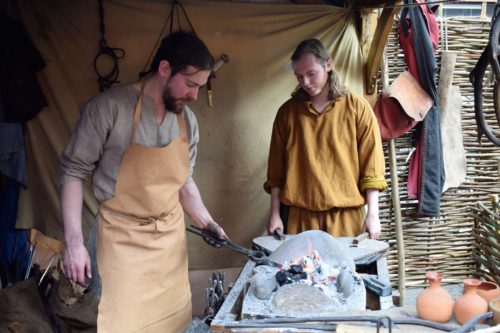
From the JORVIK Viking Centre we went to nearby Parliament Street where the Viking Encampment was located. The encampment is set up with Viking stalls, where you can watch craftsmen make wooden bowls, jewellery and Viking combs, as well as blacksmiths at work and even a Viking tattooist. At one end is a large tent where little ones can try their hands at making some Viking crafts. There’s even a Viking long-boat to have a look at. We really loved this area and returned to it several times during the day, the boy and I especially liked watching the wooden bowl making.

Days Out: Visiting the JORVIK Viking Festival

Before lunch, we visited Barley Hall, which is tucked away in the backstreets of York. Barley Hall is a reconstructed medieval townhouse which was originally built around 1360 by the monks of Nostell Priory near Wakefield. Extended in the 15th century; Barley Hall went into a slow decline and was eventually bought by the York Archaeological Trust in 1987 and restored into the museum we see today.

It’s a really interesting museum, and during the Viking Festival, it is playing host to a number of special events and exhibits. We went along to see the Seers and Shamans: Magic in the Viking Age exhibit. There were lots of interactive activities for children to do, and lots to interest adults. It’s such an interesting museum, especially if you’re interested in domestic history.

Moving on from Barley Hall, we headed over to the St Sampson’s Square Stage to watch a Viking Shield Maiden do battle with a Viking Warrior. This was really interesting and my boy loved watching them battle. They battled and then talked us through each move and why they’d made each move. We learned a lot about how Vikings fought, and it was good to see some axe wielding and sword swinging close up.

Days Out: Visiting the JORVIK Viking Festival

We’d filled a whole day with Viking Festival fun, but somehow we’d hardly scratched the surface. There was so much more that we wanted to do and we were all regretting not booking a hotel for the night and staying another day. Next year perhaps.

The programme of events for the JORVIK Viking Festival is packed and varied; with something for every kind of Viking enthusiast. If you’re visiting it’s worth deciding beforehand what you can’t miss and what you’d like to see and do. Book ahead for anything the programme recommends you book for and do spend some time on Parliament Street, it’s brilliant.

The full programme of events for this years JORVIK Viking Festival is available at  www.jorvikvikingfestival.co.uk


Days Out: Visiting the JORVIK Viking Festival

Read my preview of the 2019 JORVIK Viking Festival here.

Teatime Recipe: Anglesey Cake

Sadly the days where the nation stopped for afternoon tea are behind us. I like baking cakes, so most weekends we do make time for a slice of cake and a mug of our favourite brew. With St David’s Day coming up I baked an Anglesey Cake, I do like to bake seasonally if I can.

Anglesey Cake is not especially well known. Anglesey Cake is darkened with treacle so it appears much richer than it is was often served at weddings where the families couldn’t afford a proper wedding cake. It’s a light fruit cake which is fairly cheap to make and just the thing to serve for afternoon tea.

Teatime Recipe: Anglesey Cake

It’s certainly very easy to make, it rises well and looks a treat on the table. It would be a good bake for the novice baker to try.

Anglesey Cake

Ingredients:

100g butter or margarine
75g soft brown sugar
2 tablespoons of black treacle
1 egg
275g self raising flour
2 teaspoons ground ginger
2 teaspoons ground mixed spice
1/2 teaspoon of bicarbonate of soda
200ml milk
100g raisins
75g currants

Teatime Recipe: Anglesey Cake

How to make Anglesey Cake:

Pre-heat your oven to 180° and grease a deep cake tin (I used an 8 inch tin). I also lined my cake tin with baking parchment for good measure.

Cream the butter or margarine with the sugar. Once it’s light and fluffy, add the egg and treacle and combine. Sift the flour, ginger and mixed spice into the mix and gently mix into a thick batter.

Stir the bicarb into the milk and whisk until it is fully dissolved, gradually stir this into the cake mixture, add the dried fruit and make sure the cake mix is well combined. Pour the cake batter into the cake tin and bake for 50-60 minutes.

Once it’s baked, remove from the oven and leave to cool. The cake is best baked 24 hours before you plan to eat it. It’s nice served plain with a good strong cup of tea, but I like it with some nice crumbly cheese like Caerphilly. Fruit cake and cheese is a traditional combination, believe it or not.

Whether you’re baking this as a St David’s Day treat, or just because you like the look of it, it’s a lovely light fruit cake which won’t break the bank to bake. Happy St David’s Day!

If you enjoyed this, you might also like my “works every time” Victoria Sponge Recipe.

Teatime Recipe: Anglesey Cake


FREE Printable: Bookmarks for Adult Colouring

If you’re an avid reader, how do you keep track of where you are up to? Do you leave your book open at the page? Do you fold a corner over, or do you use some kind of bookmark? Have you ever thought of making your own bookmarks?

A nice bookmark can take pride of place between the pages of your book. There’s something really lovely about a good bookmark. In the past I’ve used everything from bus tickets to post it notes to mark where I’m up to in a book, but that’s usually a temporary solution. To solve the problem, I have designed four very different bookmarks to print and colour myself.

They’re really simple to do. Just print them out on card, colour them in however you like; cut them out and they’re ready to go. If you’re feeling fancy you can punch a hole in the top and thread through some ribbon or a tassel to give your bookmarks a bit of finesse. To make your coloured bookmarks last forever, you could cut them out and laminate them.

Modern bookmarks are available in a wide variety of materials in a range of designs and styles. Many are made of card, but you can also find bookmarks made from paper, ribbon, fabric, felt or plastic.

Some bookmarks can be very ornate and expensively made, some people use bus tickets, post-it notes or scraps of paper to mark where they are up to in a book. If you know someone who uses an old bus ticket, why not make them a pretty bookmark they can treasure and enjoy using forever. Sharing is caring and all that!FREE Printable: Bookmarks for Adult Colouring

Download your FREE Bookmarks for Adult Colouring here.

There are four really different designs to colour in. Which is your favourite?

If you enjoyed this, I have quite a wide and varied selection of printables here, including these Valentine’s bookmarks for children.

FREE Printable: Bookmarks for Adult Colouring

Book Review: Paperscapes – The Spectacular Journey Into Space

Last week we reviewed The Amazing World of Animals, a Paperscapes books from Carlton Books. This week we are taking a look at Paperscapes – The Spectacular Journey Into Space. The Paperscapes books are beautiful hardback books, filled with die-cut images and facts and information about space.

Discover space as you’ve never seen it before! Take a look at the most fascinating machines to explore the solar system and beyond. As you fly past the planets you’ll meet space probes, robotic rovers, satellites, space stations, rockets and more. Discover something new with every turn of the page.

The Spectacular Journey Into Space takes a look at the wonders that can be found in space, both natural and man-made. Unlike the other books in the Paperscapes series, the The Spectacular Journey Into Space features 29 photographs and a number of CGI images.

Win a copy of Paperscapes – The Spectacular Journey Into Space

Written by Kevin Pettman, The Spectacular Journey Into Space is packed with all kinds of fascinating space facts. It’s an impressive collection to dip in and out of.

The Opportunity Rover has recently been in the news. It was built to last just 90 days, has ended its mission after 15 years on Mars. The Spectacular Journey Into Space tell us that Opportunity carries cameras for three different purposes; navigation, avoiding hazards and collecting images for research purposes. It was also launched by a Delta II heavy rocket and a landing craft carried it onto the surface of Mars. These are all great facts my son can look up whenever he wants.

The Spectacular Journey Into Space is suitable for children aged 7+. My 8 year old son absolutely loved it and found it an easy and interesting read. The language isn’t too simple and older children and even teenagers would find the book interesting and enjoyable.

Besides the facts, the really interesting thing about The Spectacular Journey Into Space are the dye-cut images. Many are photographs or CGI recreations and they really leap off the page. Each image has perforations around it, you pop out the surroundings leaving the image to stand out within its frame. It’s very well done and makes it a joy to read and look at.

If you like the idea of these Paperscapes books, but space isn’t your thing, there are three other books in the series –  The Incredible World of Bugs;  The Amazing World of Animals and The Fearsome World of Dinosaurs.

Paperscapes – The Spectacular Journey Into Space by Kevin Pettman is published by Carlton Books and costs £12.99. It is available online and from good bookshops.

Disclosure: We were sent a copy of Paperscapes – The Amazing World of Animals for review purposes. All images and opinions are our own.

Review: Elmer The Patchwork Elephant at The Lowry

AD – Given Press Tickets for review purposes. Not paid.

Based on the classic children’s book series by David McKee, Elmer the Patchwork Elephant is on at The Lowry on 19th-21st February. I took the boy along to the first showing of this cheery production aimed at pre-schoolers.

Elmer is a vibrant, funny and kind elephant. He’s different from the other elephants in his herd and he’s not sure he’s happy about that. He tries his very hardest to blend in, unsuccessfully, so he meets up with some of his animal friends who help him to realise that being different is just fine.

Review: Elmer The Patchwork Elephant at The Lowry #AD

Along the way he meets singing frogs, a giraffe, a lion, birds, monkeys and zebras. Soon his herd start to miss him, rejoining them Elmer realises that his friends have always valued and loved his unique personality and appearance.

Elmer the Patchwork Elephant is around 50 minutes long. It’s lively and engaging, with catchy songs, brilliant puppetry and some audience participation. The set is colourful and simple, the puppets are great fun, but the puppeteers are what makes the show. All of them were dressed in safari clothes and blended in beautifully. It’s always the mark of an accomplished puppeteer that you watch the puppet and not the person.

We really liked the songs, they’re the kind of thing we could listen to in the car and sing along to on long journeys. There were some funny moments, some touching moments and a lot of feel good stuff too.

My son is 8, but he enjoyed it, he understood the message, loved the songs and his favourite bit were the monkeys. We left with a smile on our faces and chatted on the way home about what made us different and how we could celebrate and appreciate those differences.

Elmer the Patchwork Elephant is a lovely show which is ideal for pre-schoolers and young ones. It’s left us with a serious case of the warm and fuzzies.

Elmer the Patchwork Elephant is on at The Lowry from 19th-21st February this year. For more information or to book tickets, visit The Lowry website.

Note, we were given press tickets for review purposes. I have not been paid for this post.

Kitchen Hacks: 10 Savvy Ways to Cook Food Faster

During the week I find myself throwing meals together quite quickly. I like to cook as much as I can from scratch, but this can be time-consuming. In a push it can be tempting to pick up a ready meal or a takeaway, but if you’re savvy you can cook food faster. Over the years I’ve picked up a few habits to get meals to the table a bit quicker.

Kitchen Hacks: 10 Super Speedy Ways to Cook Food Faster

Today I’m sharing some of the ways I cook food faster.

1. Most frozen vegetables can be steamed in 3-4 minutes in the microwave, just throw it in a microwave proof dish, add a splash of water and put the lid loosely on top.

2. Likewise, fresh vegetables can be quickly cooked in the microwave. My son loves baby sweetcorn, so I add a splash of water and microwave them (and all kinds of other veg) until they’re cooked.

3. If you’re making a sausage sandwich, slice them length-ways first, flatten them out and they’ll cook in half the time.

4. If you’re using the oven, as soon as you start to prep your meal, put your oven on high, you can adjust the temperature later, you just need to get it preheated asap.

5. While I’m waiting for the oven to heat up, depending on what I’m cooking, I might defrost things in the microwave first. So things like oven chips I might defrost for 5 minutes to speed up the cooking process.

6. Same with pans. Boil the kettle and/or get a pan on asap. Don’t overdo the amount of water – it will boil faster and be less likely to boil over.

7. Prick potatoes with a fork, the heat will them penetrate better so they cook quicker.

8. Jacket potatoes are an easy, fairly healthy meal. They’re best done in the oven, but you can shave at least half an hour off the oven cooking time by cooking them in the microwave until they’re just cooked through, then put them in the oven so the skin crisps up and the potato goes fluffy on the inside.

9. Portion control – you’ll cook faster if you only cook just enough instead of too much. Learn to take things off the heat when they’re just done, especially if you’re holding them before serving, the internal heat will keep them cooking a little bit longer.

10. Slow cooking seems like the opposite of fast cooking, but if you’re organised you can throw a meal together in the morning, have it cook all day and it’s ready and waiting when you get home.

What are your super speedy cooking tips? I’d love you to share them in the comments.

If you found this helpful, you can find my 7 Time Saving Cheats for Busy Cooks here.

Kitchen Hacks: 10 Super Speedy Ways to Cook Food Faster

Days Out: Taking a tour of Ordsall Hall, Salford

Last week I took some time out, met up with some friends and took a tour of Ordsall Hall in Salford. I’d been once before, during the summer to one of their outdoor theatre events. I’d had a very quick look around, but I knew I had to go back and have a proper look. I was not disappointed.
Days Out: Taking a tour of Ordsall Hall, Salford

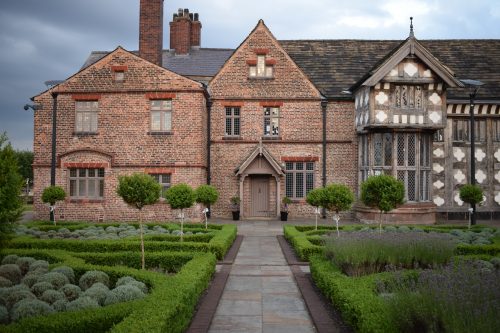
Ordsall Hall is a Grade 1 listed Tudor manor house which was first recorded in 1177. Since then, it has been home to Medieval and Tudor nobility, butchers, farmers, and Earl, an artist, priests, mill workers, cows and even several ghosts! It has an incredibly rich history and as a result is a fascinating family museum. There are rooms laid out as they would have been many hundreds of years ago, a cafe and some absolutely stunning organic gardens.

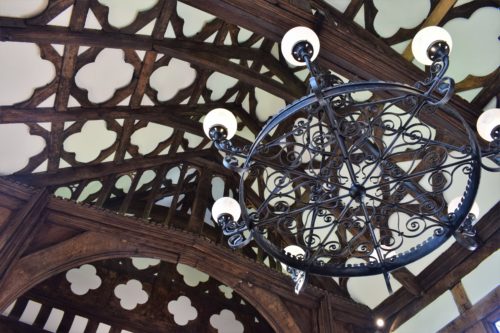
When you first enter the grounds, you’re greeted with the sight of the stunning Tudor manor house. There are quatrefoils (the white motif which looks like four circles overlapping) covering much of the exterior and lots of ancient carvings in the woodwork. The detail carries on inside.
Days Out: Taking a tour of Ordsall Hall, Salford

From the reception area, you walk into the impressive Great Hall, which is a glorious space. The walls are covered with original wooden paneling, the windows include a stunning oriel window which dates from around 1600. There are also two huge but relatively modern windows which were installed in 1897 by the then owner, Earl Edgerton of Tatton.

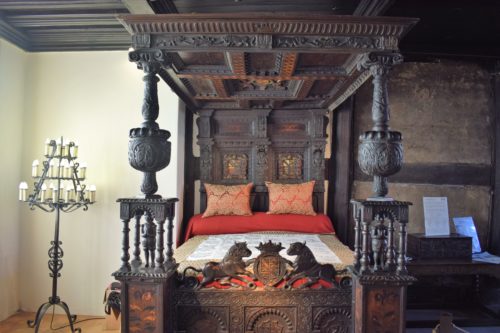
From the Great Hall, you can explore the Star Chamber, a bedroom with an intricately carved four poster bed and a ceiling covered in brass stars. The bed itself was the wedding bed of Sir John Radclyffe.  The room is quite lovely and thanks to the guides, we learned that the marks on the fireplace were where previous inhabitants had sharpened their swords.
Days Out: Taking a tour of Ordsall Hall, Salford

Upstairs we were led into the Solar Room which would have been where the lady of the house slept and spent her day. As the name suggests, the room is really light and bright. There’s another four poster bed and a wardrobe full of period costume, which visitors are encouraged to try on. This room is very hands on and children especially are encouraged to explore.

Upstairs from the Solar Room what is known as the Coat of Arms Room; this is because there is a huge stone coat of arms above the fireplace. The room was originally where the wet nurse would have slept. Again, it’s a lovely light room which they’ve decorated with wallpaper recreated from a scrap they found when they were renovating the hall. Every room is heaving with history.

Along the corridor from the Solar Room is the Italian Plaster Room. This is not open to the public, but it had a glass door so you can look inside. The room is named for it’s ornate Italian plaster ceiling which dates from around 1380. The impressive geometric plaster ceiling is the work of Venetian artists and it’s incredibly beautiful.

From there we made our way to the kitchens which were constructed in around 1600. The kitchens feature recreations of the cooking implements and the food they would have prepared and eaten. This was an especially interesting part of the building because I’m interested in the history of food.

Days Out: Taking a tour of Ordsall Hall, Salford

Climbing the staircase near the kitchens, you make your way to the attic where the servants would have slept. There’s a noticeable change in the temperature and quality of the original construction. There are two large-ish attic spaces, each with a small fireplace in. They most likely slept dormitory style and would have had very little personal space or privacy.

There are a number of permanent and temporary exhibitions on at Ordsall Hall. It’s well worth visiting the The Frederic Shields Gallery upstairs which has a number of interactive exhibits about the hall, its history and the surrounding area.

Outside there are formal gardens which looked neat and tidy in February, but back in the summer they were lush and very beautiful. There’s a small orchard; a WW1 garden and a lovely lush lawn which is where their outdoor theatre shows are performed.

Ordsall Hall have a full progamme of events for all ages, and regularly run guided tours of the house (£3.50 per person). You can explore by yourself, but going on the guided tour gives you so much more information and insight than you would normally. I found out so much more from the tour guides than I ever would have by just mooching around by myself.

I’m a massive fan of small hidden gems like Ordsall Hall. It’s surrounded by modern houses. If you’ve never visited before, the sight of this Tudor manor house in the middle of a fairly normal looking housing estate in Salford takes your breath away.

It’s also incredibly easy to get to on public transport. I got the tram to Exchange Quay and it’s less than five minutes walk from there. The hall and the grounds are free to visit, and it’s a real treasure. They do rely on donations, so I made sure to put some money in the donations box.

I am wowed by Ordsall Hall. I’m going back over half term with my son to take part in some activities and give him the tour. He’s already excited about the prospect of encountering one of the resident ghosts!

For more information about Ordsall Hall, visit their website.

Days Out: Taking a tour of Ordsall Hall, Salford

Disclosure: Ordsall Hall is free to visit. I have not been compensated for this post; I’ve only written about it because it’s an incredible place to visit. I’m a big history lover. If you love history, you need to visit. It’s free.